Showing posts with label triathlon. Show all posts

Thursday, September 08, 2011

2011 Ironman Louisville Race Report

How to pronounce this city's name?
I've been wanting to get this posted for about a week now, but have been to busy to get it done. It's finally time! I'd like to apologize in advance for the lack of race photos - I haven't been able to download any from the race photographer website yet. When I am able to, I will add some. In the meantime, please enjoy the photos I took in Louisville both before and after the race. The race photos can be viewed here:

http://www.asiorders.com/view_user_event_video.asp?EVENTID=75726&BIB=2863&S=230&PWD=

What follows are my thoughts about my very first full Ironman race. On August 28, 2011, I successfully completed the Ironman Louisville triathlon. My overall time was 14:11:17. The full breakout of my times is below.


This was a well-run race on many levels. The race management spared no detail. There were an abundance of aid stations on both the bike and run courses, and they were well-staffed with helpful folks. There were a number of port-a-johns available on the course (a lack of which I have taken issue with in previous races, such as the 2010 Ironman 70.3 Taiwan).

The mighty Ohio, as seen from the official race hotel (transition area is at center, in the green grass field, and if you look very closely out in the river, you can see some of the buoys marking the swim course)
The race course

Swim

There was certainly an “uphill” and a ”downhill” portion of the swim. The uphill was going upriver against the current. Once we made the turn past Towson Island and headed downstream, things got decidedly easier. Nonetheless, this 2.4 mile swim was the longest I had ever done. Note to self: train better for the swim next time.

Bike

IM Louisville bike course went northeast out of Louisville and made two laps before heading back into the city
The 112 mile bike course consisted mostly of rolling hills and flats. There was a variety of scenery, including horse pastures, suburban-type dwellings, small towns, and rural highways.

Run

The marathon was on a very flat course running through downtown Louisville, past the University of Louisville, Churchill Downs, and almost out to the airport before heading back from whence it came. The course passed through one area near downtown filled with historic homes and another ethnic area nearby. We had to make two loops of the course to make the total mileage of 26.2 miles.

Transition area, the day before the race
Weather and Race Day Conditions

We were fully blessed this year with conditions far milder than years past. People on the course were saying that last year it was 98 degrees with high humidity on race day. This year it got up into the mid-80’s and the humidity seemed pretty comfortable to me, someone who lives in the dry climate of Denver. We were lucky this year! There was a little bit of wind on the bike course, but not enough to significantly degrade riding performance. We may have Hurricane Irene to thank for the milder weather this year.

Race execution

I ran what I would consider to be an almost perfect race in terms of my execution. I stayed within my abilities, remained patient, and kept the long view necessary to complete the race. Before the race, I sketched out what I thought my times would be:

0740 swim start (actual 0743)*
0940 swim complete (actual ~0922)
1000 begin bike (actual ~0930)
1800 bike complete (actual ~1650)
1815 begin run (actual ~1700)
~2315 race complete (actual ~2200)

Obviously, in making my estimates and having never run this distance a race before, I consciously tried to err on the side of allowing a little bit more time than I though each piece would actually take. I was almost dead-on with my estimate for the marathon (5 hours predicted vs. 4 hrs 58 min actual).

Issues:

My GPS only lasted about 5 hours into the bike ride. I guess if I were a faster cyclist, this wouldn’t have been a problem – just complete the ride before the battery dies! But I knew that if I went faster than about 15 mph average on the bike, my chances of not blowing up on the run would be significantly decreased. So, keeping within my abilities, I went slower than I figured I really could. I have a hard time doing this unless I can located another rider to pace off of. Note – this does not mean draft off of, I keep my interval in keeping with the rules of the sport. I found a few “pacers” out there – athlete 2620 during the first couple hours, a different chap toward the end of the race. The only time I ran into an issue with keeping my pace conservative was when I was on the part of the course where riders have to do two laps of the same section. Here, there were faster riders already on their second lap mixed in with folks like me who were taking it a bit easier on their first lap. When I am surrounded by riders going faster, I just want to push myself harder, too. It was hard to resist that urge, but thankfully once I started my second lap, the faster riders were on their way to the finish and the riders left on the course were by and large not as aggressive. This helped me keep my pace. But back to the GPS: I made the mistake of staging it at the transition area the day before the race. I should have known better than to do this, for having used it quite a lot since acquiring it in 2007, I know that best results are obtained when taking it directly off its charger immediately before use. As it was, the device started to give me low battery warnings only 2.5 hours into the ride, though I was able to coax it on for another couple hours before it gave up the goat.

IM Louisville bike graph
The early demise of the GPS had implications for my ride and for my run. Essentially, thereafter I had little means to determine how fast I was going and the time of day. This is why it was doubly important for me to find a “pacer” who I could use to keep my from going too fast towards the end of the bike portion.
I think the lack of a GPS worked out well for me on the run. This allowed me to just go by feel and not worry about what kind of pace I was keeping mile by mile. Instead, from very early on in the run, I adopted a run-walk strategy that entailed running several blocks (usually between 3-5, but sometimes more), then walking a block or two, and repeating this over the entire 26.2 mile course. As much as practical, I incorporated walking through the aid stations into this regimen. I figure this ended up having me take between two and three walk breaks per mile.

This run-walk strategy was also conducive towards favorable gut conditions. In past long-course triathlons, I think I have tried to consume too much on the run, and the sloshing effect made me have issues with cramping, sideaches, and general gastrointestinal (GI) tract distress that is not conducive towards timely event completion or an enjoyable race experience. This time, I decided to only consume liquids and to sip them slowly while walking through the aid stations. This would ensure that the nutrients made it into my stomach and by not eating solids, I would avoid the associated delays in gastric emptying that I think have caused me problems in the past on the run segments of half Ironman races.

For those who made it to the end
My go-to drinks were cola and chicken broth (the latter of which I began to think of as a “liquid pretzel” from the yummy saltiness it provided) alternated at aid stations along with a cup of water. I completely avoided the sports drink offering on the run and ate no gels throughout the entire race. In fact, the only solid foods I ate during the entire race were one (1) powerbar (split into two halves), several bananas, and a few pretzels. I drank a lot of sports drink on the bike portion (hence why I did not want to drink any more of it once I got to the run, plus I think that the non-diluted strength of the drink slows gastric emptying as well, which is not as much of a problem on the bike as it is on the run), along with quite a bit of water. I also dumped quite a few bottles of water over my head and on my jersey and shorts to help keep cool on the bike.

To combat heat on the run, sponges soaked in ice water and ice cubes were available. A few times I dumped some ice into my hat and put it back on my head, but most of the time that ended up being too cold for my scalp. I liked better to grab 2-3 sponges and put one in my hat and use the others to squeeze cold water onto my shirt.

Public art in Louisville
The bike ride twice passed through the town of LaGrange. Riding down the main road lined with spectators yelling and cheering was cool – it felt like I was in the Tour de France! Naturally, I was hammering through this portion of the ride both times.

On the swim, I had a hard time sighting the buoys used to mark the swim course. This was due to two problems: fogged up goggles and scratched up lenses on said goggles. (Not to mention that I am nearsighted.) I had to stop numerous times to get my bearings, slowing my time.

What would I change about the race? I would have prepared better. The race program from the Ironman lists various stats associated with the “average” Ironman athlete. Age-wise, I am pretty much dead on (average age: 37), but with respect to the average training distances claimed, I am lacking. For instance, according to the race program, the average Ironman athlete swims 7 miles each week, bikes 225, and runs 48. My averages are way, way below all of those. So certainly I could benefit from greater training volume.
I would also like to have at least one “support human” at the race. It would have been nice to have someone I knew at the finish line (though I was well-taken care of by the volunteers there). It was also a bit of a hassle to have to go get my bike and gear from the transition area after finishing the race (a support human could have done that for me).

What’s next? I know that I certainly want to continue to run triathlons, though it is possible that I may stick to the half Ironman and below level. I’ll have to wait a couple weeks to see what I think for sure. I definitely want to take advantage of the various events offered out in Colorado.

These are made in Louisville
All in all, Ironman Louisville 2011 was a fantastic experience and I commend the race organizers and all the volunteers who made it happen! I am also happy that my first Ironman experience ended up taking place in the U.S. – while the novelty of running Ironman China would be great (as I had planned to do in May of this year before the race was cancelled), I have a feeling that the race organization would have been lacking and it would have been a much less fulfilling experience. Ironman Louisville was the culmination of 10 years of racing and training for me and I look forward to seeing where I go in the future.

One of Louisville's sister cities is Jiujiang, People's Republic of China
*IM Louisville's swim is unique as that it is a time-trial start, as opposed to mass or wave starts at virtually all other races. What this means is that instead of having all members of an age group (for instance, males aged 35-39 yrs) start the swim together (a wave start), as is fairly standard at many triathlons worldwide, at IM Louisville each athlete jumped into the river singly in succession (OK, actually there were two lines to make it go a bit faster), which explains why even though the race actually began at 7:00 AM, I did not enter the water until nearly 45 minutes later. Luckily, the 2 hour 20 minute swim cut-off did not start until the last athlete entered the muddy waters of the Ohio River (which was much more pleasant to swim in than I had feared it might be. It was a comfortable temperature and it did not smell of sewage, unlike the previous triathlon which I swam in a river for.).

Wednesday, March 23, 2011

Race Report: 2011 Ironman 70.3 Singapore

2011 IM 70.3 Singapore finisher's medal
Wow, just wow. This race was a stark contrast from my last race two weeks ago. It was so well-organized! Plus, Singapore is fantastic. I would love to spend more time there. Alas, this trip is over. Let's hear more about the race and the trip.

These were a welcome sight near the race start/finish
Good: Port-a-johns and other on-course restrooms; good shade on most of the course (important due to the climate - very hot and humid), flat bike and run courses; very little wind; rain came right when I needed it (on the run); fantastic accommodations for families at the race venue (see more on this below); race materials very informative (competitor's guide, etc.); airlines shipped my bike for free both ways! (I was expecting to pay at least $75 each time, per the airlines' published guidelines. Thanks Dragonair/Cathay Pacific!)

Old enough now to get some work out of him :)
Other: The race needs to coordinate a better system for getting to and from the race site (shuttle buses would be optimal). Getting to the race in the morning wasn't a problem, as that we were able to reserve a taxi the night before via the hotel concierge. After the race, however, we searched in vain for a taxi cab for at least an hour after the event was over, and we got a cab relatively fast (others were waiting much longer than we did).

At the pre-race briefing, Singapore International Convention and Expo Center
This triathlon was my fifth at the half-Ironman distance. I have also completed five marathons and a number of half-marathons, as well as numerous Olympic- and sprint-distance triathlons, 5K, 10K, and 15K runs, and a few century and metric-century bike rides (organized events, not just training rides). All that is missing is a full Ironman. (Coming in May!)

The transition area, T-20 hours or so
As far as my goals for the race, I think I mentioned here not too long ago that I was treating this race as a sort of "preview" for racing internationally at IM China in May. I wanted to see what lessons I could take from this and apply to the next race, the big race. There are a couple. First, I forgot my bike bottles. It wasn't a problem as that I was able to easily purchase some replacements at a mall across the street from our hotel. However, I am not sure that the city that hosts IM China will have the same sort of facilities readily available, so I need to remember to take them next time. The second issue was much larger, and will possibly be much more difficult to deal with in China. It is regarding bike mechanic availability to build my bike up after traveling with it. It was somewhat of a hassle to locate and get my bike to a bike shop in Singapore to have it put together after being transported in a travel case (and it wasn't cheap either). It was even more tricky to get them to put the bike back in the box after the race, due to problems with their hours of operation and our timeline for departing Singapore. In short, if it was that difficult to take care of this issue in easy-to-navigate Singapore, it will probably be ten times harder in China. I have to have a better plan going in to take care of these issues ahead of time.

The home stretch!
Surprisingly, my finish time was within 5 minutes of my time at IM 70.3 Taiwan last fall. My training getting ready for this race had been pretty cruddy, so I figured that coupled with a challenging climate (heat and humidity) would leave me significantly slower. Not the case.

Let's now talk about the various parts of the race.

Heading out into the South China Sea
Swim: The waters of the South China Sea were like distilled in comparison to the murky depths of the Love River two weeks ago. No sewer smell here, folks, and the water was a very comfortable temperature. There was a bit of a current that made a couple segments of the two-lap course a little iffy, though. I don't know that I am ever going to enjoy swimming with so many people at one time - it's just not very much fun. I did really like how the race start was broken up into multiple waves, about five in all. I started a half an hour after the first wave. That makes it so you only have to swim with a few hundred people starting off. In contrast, the IM 70.3 Taiwan was a mass start - all 1200 or so athletes going out all at once. IM China in May will be a mass start...not looking forward to that. I'm also not looking forward to how cold the reservoir water near Beijing will be in May - I definitely need to get a wetsuit, pronto!

Swim - check!
Near the cycling start point (note the good shade trees - most of the course was like this)
Bike: It was a three lap course along quite a scenic route out past the airport and up along the east coast of Singapore. If a person was in good cycling shape (I wasn't, hence the very conservative speeds I was clocking), this would have been a very fast course. Interesting note: as I was starting my second of three laps on the bike, the elite men were starting on the run and the run route paralleled the bike route for a short distance. I was cycling along at a moderate pace and was barely passing these "machines" absolutely flying on the run course! It was pretty amazing to see - these folks are able to go all-out for the whole course. I'd "blow up" a mile into the run if I tried to push that hard!

Coming through the spectator area near the run start/finish
Run: It was a flat course along the ocean - two laps. Saw a Singapore Airlines A380 airplane coming in for a landing as I ran on my first lap. (That's the new, giant passenger aircraft manufactured by Airbus that looks like it is top heavy because it has two levels throughout the cabin.) The rain started when I was about halfway through my second lap, and it was just what that doctor ordered. The sun had begun to come out from behind the clouds towards the end of my bike segment and I was really starting to feel the heat on the parts of the run course that weren't shaded. Once the rain started, it really cooled me off and it made no difference to me that I was getting rained on - after all, I had been pouring water on myself to cool off at every aid station, anyhow. The only drawback was that my shoes also got wet, which created conditions that could have created some nasty blisters if I had to keep on running much farther (such as in a full marathon in a full Ironman race).

Catching some air!
Regarding the family accommodations I mentioned above, this is the first race I have seen where there were booths and other diversions set up for the families of competitors. I'm talking about a "bouncy house"-type thing (see the photo - John bounced around in it so much be split open his shorts in two places!), cotton candy and popcorn stands, arts and crafts, face painting (again, see the photo nearby) and various other carnival-type games. And get this - it was all FREE! Attention all other races and events: learn from these folks in Singapore! They did this up right.

We found a ZOMBIE in Singapore!
Can you tell that he likes dinosaurs?
Singapore itself made a great impression on us. I had been there once before (1998), but didn't remember it being as nice then as it was this time around. Everything is so green, there is foliage everywhere, and all of it seems to be manicured and pretty. The air pollution there is not bad, at least it wasn't during our visit (perhaps like other cities in the region, it is better and worse at specific times of the year) and the city is very clean. There are no scooters zipping around the roads and sidewalks making nuisances of themselves (note to Taiwan), nor are there packs of stray dogs wandering about and defecating all over the place (another note to Taiwan). Most surprisingly, they openly advocate that people drink the tap water! Singapore is a city-state of something like 4.5 million people, and is located in Southeast Asia, and you want me to drink the tap water? So we did, and it was good. No crazy diseases (at least not yet). Can't drink the tap water here in Kaohsiung. I'd be open to going back to Singapore anytime, maybe even working there, if I play my cards right.

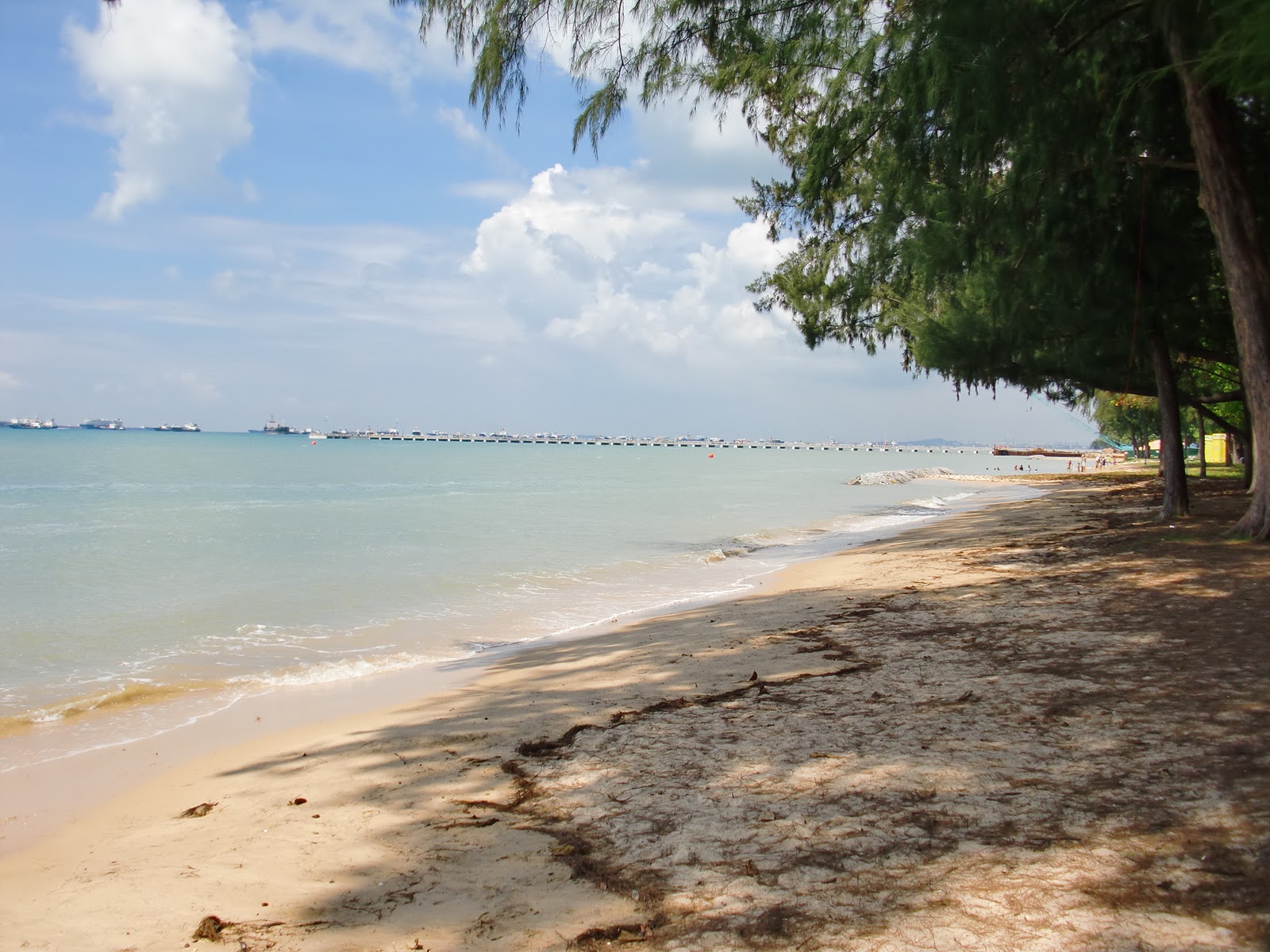
Typical scene at East Coast Park
Looks quite idyllic, doesn't it?
Singapore is also an interesting place because of the cultural diversity. There are three main ethnic groups there (Chinese, Indian, and Malay) and because of the British influence, virtually everyone speaks English in addition to one of the other ethnic languages (Mandarin Chinese, Tamil, or Malay). All signs appear in all four languages (and they even add Japanese at the airport). And you know what? They have bookstores stocked with books IN ENGLISH! After the repeated disappointment of browsing bookstores in Taiwan with only a handful of books in English, it was great to walk into a Borders with easy-to-read books in English everywhere you looked. Can't wait to actually walk into a Barnes and Noble once back in the U.S. (my preferred chain bookseller).

Bottom line - great event, great trip! Go see Singapore, people. And do the race.

GJS

Tuesday, March 15, 2011

"Confucius' Revenge"

With some new friends just before the race start
The triathlon last week wasn't done with me when I thought I was done with it. No, come Monday afternoon, I was spending an inordinate amount of time in the bathroom with a case of diarrhea the likes of which I had not experienced in many years. Thank God for Immodium! I also was feverish and lethargic. We figure it must have had something to do with the Love River water. Remember how I mentioned it smelled like a sewer? You can't really go swimming in any body of water and not end up ingesting at least a little bit of it - it's just not possible, no matter how hard you try. I also discovered a cut on my foot after exiting the water on race day, probably from another competitor's fingernail amidst all the flailing that takes place at the beginning of the swim leg, when people are clawing to get past one another until the pack eventually thins out some as the race progresses. Anyhow, we figure I got sick via one of these two methods - either inadvertent ingestion or infection via my open wound. Took me about a week to kick it. I'm feeling much better now, but being laid low by "Confucius' Revenge" pretty much removed any chance I was going to have for additional training after the Kaohsiung triathlon and before heading to Singapore for the Half Ironman. We travel in just a few days. What this all boils down to is that the Singapore race, due to issues with my training and the anticipated hot and humid weather (which the very mild winter and spring - much cooler than last year - in Southern Taiwan has not helped me prepare for), is going to simply a completion exercise for me. Its greatest utility may in fact be the "rehearsal" aspect that it is for my Ironman aspirations in May - after all, there are a lot of moving parts when traveling internationally to a race, and it's best to do it a time or two before really wanting to do it right, which is basically what I am doing with this trip to Singapore. I will make note of all the things that I forget (gear, equipment, etc.) or can do better in May and hopefully make that experience better than it would have been not having had the chance to conduct a rehearsal race. Plus, it will be neat to visit Singapore - after all, it's been nearly 12 years since the last time I was there! And my family members have never been there. New stamps in the passports - yay! Looking forward to the trip, though I feel that race day will be a long one.

Oh yes, and the results from the Kaohsiung triathlon were posted online, here. For your convenience, I am pasting my results below. (FYI - the first column after the name column is swim time, then bike time, then run time, then place within the division [I'm in the 35-39 bracket]. The final column in team affiliation - I was one of the few without such a designation.) As you can see, my overall time estimates were about right. It is obvious, though, that the transition times are added to the respective event times (for example, my own calculations on my bike time were about 1 hour 12 minutes, while these results add about 10 minutes to that, which approximates the transition time). Anyhow, have a look at the rest, if you like.


 GJS

Sunday, March 06, 2011

Race Report: 2011 Kaohsiung Romantic Love River Triathlon

The calm before the storm: race venue, T-16 hours
Look, I didn't name the race, OK? It's a silly translation from the Chinese - nothing about "romantic" in there, except that the river really is called the Love River.

There, now that that's out of the way, let's talk about the race!

The good: The course was flat and fast. The river was slow-moving and free from waves and currents. The swim start was conducted in three waves, making it a less "punchy" situation in the water than when a mass start of all competitors is used. The weather was highly cooperative (read: the sun didn't come out and the day was essentially cool, with an overcast sky). There were many enthusiastic supporters cheering on the competitors. There was essentially no wind on the bike course. (BIG contrast to my last triathlon!)

Watch out for "logs"
"Other"*: The Love River is an urban river. Yes, that means that there is at least some degree of sewage drainage that reaches it. It smells a little bit like a sewer. It was hard to get past that during the first part of the swim today. Thankfully, I didn't see any "logs" floating by as I was swimming. There was a marked lack of restroom facilities both at the transition area (a middle school, which had a few restrooms that were quickly overwhelmed by the volume of participants and support personnel) and on the course (no facilities dedicated to the race - not a single port-a-john). Race materials were entirely in Chinese. There seemed to be little to no enforcement of drafting rules on the bike - there were pace lines and pelotons all over the course.

Random: This is the first triathlon I have ever seen where flotation devices were not only authorized, but seemingly encouraged! Seemed like about every other person was "swimming" with some type of "floaty". Weird.

"Floaty" at center
Let's discuss my times for a moment. I am not sure when or if official finish times will be published, so I can only go off how my wrist-mounted GPS unit describes my performance and the time on the official race clock when I crossed the finish line. I finished at about 3 hours 5 minutes on the clock, but if you subtract the five minutes that elapsed prior to my start (five minutes between waves; I was in the second wave), then you've got pretty much 3 hours flat. This exceeded all my expectations for the race! I figured I would be lucky to finish in 3 1/2 hours. (It had been a while since I had run this length of race, known as an "Olympic distance" race: 1500m swim, 40 km bike, 10 km run; so I couldn't really remember what my last finish time in this sort of race was. I just looked it up - I've got to get a bit faster to catch up to where I was in 2008!) I didn't wear a timing device of any kind on the swim, so I am not sure how that turned out, but based on the overall finish time (approx. 3 hours) and the times I did record on the bike and run, we can interpolate the approximate swim time. More on that in a minute.

Heading for the finish line
My bike time was 1:12:28, good for an average of about 20 mph (this is probably my biggest triumph of the race; I have been doing close to no cycling recently), and my run added another 55 minutes and 30 seconds. That's a grand total of about 2 hours and 8 minutes. That leaves 52 minutes for the swim and 2 transitions. Supposing each transition took 5 minutes, that would mean I did the swim in about 42 minutes. Remember, this is just an estimate. Hopefully at some point I will be able to get my hands on the actual official finish times, split times, etc.

Looks like 3:05:12 to me
I was hampered by thigh cramps on the run. At about the same place each lap (it was a 5-lap run course) I had to stop and do some static stretching and a bit of slow walking to work out cramps in my right (and later my left) quadriceps which slowed my overall run pace average considerably. Since it was only a 10 km race course, I tried to pour on a little speed, but it kind of backfired on my with the cramping. I am not going to be trying to go fast on the run in Singapore in a couple weeks (see below).

One interesting aspect of this race that made it really unique was the participation of a great number of Taiwan's military personnel. The Republic of China (ROC) Marine Corps is actually headquartered in the greater Kaohsiung area and there is also a major ROC Navy base here, too, and there were no shortage of personnel from both services participating in the race.

Me n' my boy
As for the future, I won't have much time at all before it is time to race again - exactly two weeks from today I will participate in my 5th Half Ironman race in Singapore, where the course might be flat, it might be calm (not windy), but it won't be cool. (Daytime highs there this week have been around 90 degrees, whereas it only got to about 80 degrees here today.) The Singapore race is notorious for being hot, in fact it is advertised as being quite similar to the Ironman World Championship course in Kona, Hawaii, in terms of the climate and environment. Since I've raced on the Kona course twice (just the Half Ironman, not the full shebang), I know that it gets really hot out there. The temperature and climate in Singapore will be a challenge for me.

I need to keep up the training, because before you know it, it will be time to head to Beijing in May for the big one - 2011 Ironman China. I had a scare in this race last night - I saw something online that said wetsuits were compulsory for the swim (turns out they changed that at the last minute, which is good for me, because I don't have one). I am going to need to pick one up soon, though, because I am sure the reservoir we will be swimming in near Beijing is not going to be warm! (I recall a triathlon I did in May some years back near Kansas City - the water was absolutely frigid! I think Kansas City's latitude is a little bit south of Beijing's...)

"W I N N E R !"
Happy racing!

GJS

*A Marine aviator I once worked with told me that these are the two categories that they use during their after-action debriefs - "good" and "other" - in an effort to make the not-so-good less, umm, charged, shall we say. I kinda like that formula, and will use it forever myself.

Wednesday, November 03, 2010

2010 Ironman 70.3 Taiwan recap

Done!
Want to get this written before too much time passes since the race and I start to forget stuff.  Where to start?  Some people have expressed interest in how the mini-van driving went.  I enjoyed the utility of the Chrysler Town and Country we rented.  It had seats that folded into the floor, making it easy to take advantage of the cargo room necessary for hauling my bike and our luggage.  The auto-open side doors were nice, and it was easy to get the boys in and out (unlike when you are stooping and bending in a car to do the same).  "If the sweatpants fit..."

Before the swim start
I'm out there somewhere
 As for the race, the swim course was unlike any I had seen before.  It was a two-lap out-and-back course in which you actually had to come back up on the shore and cross the timing mat between the first and second laps.  Originally it was supposed to be a triangle-shaped course (pretty standard for these types of races), but perhaps due to the currents they changed it to the out-and-back format.  Whatever the case, the first half (the "out" portion) of the first lap of the swim course was as bad as any I have experienced.  It was a mass start of close to 900 athletes, and it seems like the preferred swim stroke here is the breaststroke, with its attendant side-flaring arm pull and frog kick.  This stroke takes up a lot of room, and made for a much-kicked and struck opening leg of the swim.  Along with the "fisticuffs" taking place between competitors, the current also seemed quite strong, pushing back as I tried to swim out to sea.  It was only on the first "back" portion that I started to get into a rhythm, finally beginning to use bilateral breathing and getting some space around me to swim more comfortably.  The water was surprisingly warm (wetsuits were optional and lots of folks were wearing them, though I definitely think they were unnecessary in terms of water temperature) and pretty clear - I could see all the way to the bottom of the ocean for most of the course.  I came up on my first lap in the water at about 27 minutes and figured I would be able to beat that pretty easily on the second lap since the crowd had thinned out a lot and I was swimming much more comfortably, but perhaps due to fatigue or increased current, the second lap was actually slower, about 30 minutes.  My total swim time was 56 minutes 34 seconds. (By the way, full results [PDF] are at http://www.ironmantaiwan.com/editor_images/im-70-3-tw-final-res.pdf; do a search for my bib number, 391.)

"Quick draw" caught me going from the swim to the transition area
I was unconcerned about how long my transitions took and tried to stay relaxed.  The path from the beach to the transition area (TA) was long!  We had to go up a couple flights of stairs and then I had to transit the entire length of the TA to get to my bike.  I should mention the weather in Kenting, Taiwan, on race day - absolutely gorgeous!  Blue skies, lots of sunshine, and seasonally cool - about 80 degrees for the high temp.  I think that the cooler temperature in comparison to the site of my last 2 Half Ironman races (Hawaii, in June) really helped me (though I still got sunburned - one of these times I will learn).  There were some pretty gusty winds, which made the bike course interesting, but I will talk about that a bit later.


I felt really good on the bike course. (see above)  It was also a two-loop course, this time essentially circumnavigating the Hengchun peninsula in southern Taiwan.  The course was mostly flat, except for two uphills just after leaving the TA, and then one climb portion covered once per lap thereafter.  There were many parts of the bike course heading north along the coast where you basically had the ocean on your left side and mountains on your right side.  It was quite scenic.

Enjoying the scenery
The gusty winds were coming from the north - northwest, which gave a nice push coming back in on the second half of each lap.  I tried to keep from over-extending myself on the bike, which tends to lead me to excessive cramping on the run portion (I know from past experience), but still putting in a decent effort.  I think I struck the balance well, as evidenced by my run performance.  My overall bike split time was 3 hours 8 minutes 25 seconds (about 17.4 mph average).


Unlike in past Half Ironman races, I only had to stop due to cramping (hamstrings both times, first the right and later the left) twice, at 5 miles and again at 10 miles.  I was able to easily address the cramping with only 10-15 seconds of static stretching followed by 10-15 seconds of walking.  Then I was back on my way.  I ran all the rest of the course, with the exception of aid stations.  I stopped and walked every one of these, making sure to get the food and drinks I needed, as well as sponges to keep cool.  Once I was done, I ran again to the next aid station.  I believe this tactic, which gave me 11 short walk breaks on the course (there were aid stations almost every mile), along with my conscious effort to find and run with other competitors who selected a pace a little bit slower than what I would self-select to run, allowed me to be relatively cramp-free on this half-marathon. (You can see some photos of me using this tactic, as well as all the other race-sponsored photos [13 in all] at http://www.finisherpix.com/; go to "Select Event" - Ironman 70.3 Taiwan 2010; enter my bib number [391], press "Go".)  My run split was 2 hours 20 minutes 54 seconds (a pace of about 10 minutes 25 seconds per mile).  I actually did not look at my run time at all on the course - my pace wasn't important to me, finishing with as little cramping as possible was.  Mission accomplished!

In this race, I believe I learned that doing this type of race and not being completely destroyed at the end is possible for me, IF I race smartly and don't overly concern myself with the amount of time I am running it in.  This is the first time I crossed the finish line on a long-course triathlon and felt like it would be possible for me to extend my effort out over a longer course...

I didn't really have a good idea of what my finish time was as I crossed the line (like I said, I hadn't really been keeping track very closely, unlike in some past races when realizing I wasn't going to be able to make whatever time goal I had set before the race my morale began to flag).  In all, it was 6 hours 35 minutes 50 seconds.  I had forgotten all but my most recent Half Ironman finish time (Hawaii, 2008), and I knew that I beat it by a fair margin (about 20 minutes, as it turns out), so I was quite happy with the improvement.  Later, I looked up all my Half Ironman times.  I have developed quite an interesting patter of doing these races, at least in the past 3 iterations.  My first race was actually my fastest by far, the 2002 Pigman long-course race in Iowa (5 hours 37 min 34 sec).  Then I raced Half Ironman-length events again in 2006 (Hawaii, 5:50:19), 2008 (Hawaii, 6:54:53), and now 2010.  I fear I will not keep the pattern going forward, though - I have my eyes on another Half Ironman race in the spring (March 2011) in Singapore, which will set me up for the ultimate goal - the full Ironman China race near Tianjin, People's Republic of China, in May 2011.  There's no time like the present to do it, and I believe it's time.  Who's with me?

I have a couple criticisms of the race.  First of all, there were no port-a-johns on the race course or even in the TA.  The only restroom facilities I am aware of near the TA were at the beach, near the swim start, very inconvenient if you need to use the facilities while transitioning.  I did notice two "rest area"-type areas along the bike course that evidently could be used by competitors as needed, but this seemed quite inadequate to me.  I pulled off in the bushes along the side of the road during the run about 4 hours into the race for a quick pit stop, since no facilities seemed forthcoming, but what about the women doing the race?  This needs to be addressed in future iterations of the race.

Second, the race course and even the host hotel changed several times before race day.  I understand that this was the first year of the event, but it's pretty inconvenient to have to keep adjusting your plans for the race as the organizers sort things out.  I figure this will be less of a problem during future iterations of the race.  I actually am glad the bike course was changed.  Originally, it was going to be an out-and-back course that went from Kenting down around the southern tip of Taiwan and back up the east coast a ways.  I drove this area the day after the race and the terrain was much more challenging there than it was on the actual (Hengchun peninsula) race course.  That and out on the east coast, the winds were absolutely WAILING.  I felt like I was about to be blown over as I stood and looked out over the Pacific Ocean.  I am glad I didn't have to bike out there for the race.

The wild, windy east coast of Taiwan
I'm glad to be writing this some 9 months after I basically wrote off being able to run triathlons and other races again due to lack of training and deconditioning.

GJS

P.S. I found this additional account of the race, from the fellow who finished 2nd overall: http://www.triathlontribe.com/blog/post/show/id/77-Jamie-Whyte-Blog-My-best-Ironman-70-3-result.  Looks like I am not the only one who thought the winds and current were challenging.

Coffee ban is (temporarily) off

My view
Enjoying a large cup of black coffee this AM while I study and write stuff (like this post).  The coffee ban has been temporarily lifted during the triathlon recovery period (about a week).  I think abstaining from coffee for the 2 months prior to the race helped - I was then able to take advantage of the well-demonstrated performance-enhancing benefits of caffeine that were unavailable to me when I was habitually drinking coffee.  I had 2 cups of coffee at the hotel the morning of the race, and enjoyed a couple espressos on Monday.  Now I am having more black coffee.  Delicious!  But a rare treat for me now.

GJS

Thursday, October 28, 2010

Number Four

Soon we'll be taking a trip to Kenting for my fourth Half-Ironman triathlon.  Normally, I'd provide information about how you could follow along with my progress in the race online, but as far as I can tell, that is not available in this event.  If, for some reason, you discover that it is available and you want to follow along, my bib number will be 391.  The race website is http://www.ironmantaiwan.com/.

Wish me luck!

GJS

Friday, August 20, 2010

This post NOT brought to you by...

From Wikipedia

That's right folks, I hope you are sitting down.  It's been nearly 3 weeks since my last coffee.  I know, I know, hard to believe, but in the midst of our visit to Beijing, I decided to take a break from caffeine for a while.  Just to prove to myself that I can do it.  I used to semi-regularly take breaks from caffeine, maybe 5 years or more ago, but since I got back into the "gun club," let's just say there hasn't been much of an occasion to do it.  What was the catalyst in Beijing?  Nothing in particular, really, I just felt like it was time.  Well, actually, it was a little bit inconvenient to get a decent, affordable cup of coffee where we were staying at, and so I just decided to go without for a few days...and that carried over to after we got back to Taiwan.  Of course, here I have easy access to my own coffee machine, beans, and all other necessary materials required to brew a fine and affordable pot of coffee...but I just felt like I wanted to go with no coffee for a while and see what happened.

Sure, I was a tad edgy at first, but since then I feel like I have slept better, gotten out of bed in the morning easier, and had more even energy levels throughout the day, without having to suck down a pot of coffee to keep myself going!  It's been pretty nice.  I have even been able to get out and do my workouts in the mornings (well, most mornings, anyhow - look for an overdue post on my July and August workouts coming before too long) without ingesting any type of caffeine beforehand, something that for a long time would have been a bit of a joke (and not a funny one).

My intent is to regain being able to use caffeine on a select basis as a performance enhancer / ergogenic aid for exercise and sport.  Caffeine's performance-enhancing properties for endurance sport are well-documented and I have known of them for a long, long time - but it only really works if you don't customarily use it.  I plan to break it out when I run the Taiwan Ironman 70.3 triathlon at the end of October and perhaps for select long training bouts before that, but not too often - I want to see how it helps me when it is "go time."

These 3 weeks have not been entirely without caffeine, though - I've had a few sodas (I like to drink soda with my burgers, that or beer, and it's not always appropriate to knock back on the 'ol "wheat juice" any time of day, you know?) and a milk tea or two, but compared to coffee, these drinks are poor sources of caffeine.  It's been a lot easier than I feared it might be.

GJS

Monday, July 12, 2010

Five months of training

This week marks five months since I resumed training in mid-February 2010.  It’s gone remarkably well, although not all has been according to plan.  For instance, at the end of June I missed about 10 days of workouts while crashing on a mess of term papers and other end-of-semester requirements.  I’ve been back at things now regularly for about that same amount of time, and already the next impingement on training looms – an upcoming trip to China.  I’ve already modified my planned workouts before the trip, focusing this week on cycling almost exclusively (if the weather holds) since I will be away from my bike for about 3 weeks, all told.  I figure while we are traveling I can still run and swim fairly easily using facilities that will likely be available at our various lodgings.

June was when I returned to cycling after about a year out of the saddle and also when I ran my semi-annual required physical fitness test for my employer.  The cycling is going well, and the fitness test was pretty good, too (indeed, the requirement that I take it during the first half of the year was one of the big factors that finally got me back out the door running in February – that and the general feeling of malaise and lethargy that comes when I don’t exercise, that feeling that I hate so much).

Let’s review June’s training (previous posts along these same lines dealt with cycling in June, May’s run training [this post only dealt with running for that’s all I was doing then, but since then I have added cycling and swimming!], and my two-month training re-cap, filed in mid-April) by taking a look at the training calendar:

I'm getting more colors on there! (It used to be all blue for running, but now I have running, biking, and swimming!)  And here are the totals for June:

I'm doing fairly well on the running (my mainstay) and the cycling, but I need to be more consistent with the swimming.  I enjoy the swims I do, but I just don't go often enough.  There is room for improvement here.

Over the five months of training, I’ve put in a total of 63 workouts in over 57 hours of training, moved over 530 miles, climbed over the equivalent height of Mount Everest (interesting how the climbing accumulates, given how flat it is around here!), and burned an estimated 51,000+ calories!  I will probably at least double all of these measures in continued training between now and my scheduled Half-Ironman triathlon race on October 30, 2010.  

Posted via email from gjsamps's posterous

Monday, April 19, 2010

Two months back on the run

Last week I surpassed two months since I started running again.  To “celebrate” this, I went 5 days without a run and got a little taste of what it was like to not exercise again.  I didn’t take much of a taste to recognize that I still don’t like the restlessness, poor sleeping, and lethargy that I feel when not exercising regularly.  Good thing broke the cycle by getting out the door for a run this morning!

 It wasn’t a long one, just 4 miles, but I already feel much better.

As I already mentioned, I wanted to talk a little about the 2 months of training that I have completed.  Let’s take a look at some of the totals:

There are a few runs, the first half-dozen or so that I did in February, where I didn’t take my GPS with me, so those are not included in these totals.  All in all, not too bad!  Not counting today’s workout, I did 23 runs, going from a run of 23 minutes on February 16 to start off my “comeback.”  Compare that with my longest run during this time, 8.13 miles in 1 hour 8 minutes and change on April 3, and you can see the progress I’ve made.  I am looking forward to taking a crack at a 10+ mile run in the not-too-distant future.

It only makes sense that with the progress I have been making that I would start to think about some sort of competitive event to use as a goal to keep me going.  Last week I started thinking about two events this fall – the Taroko Gorge Marathon and the Ironman 70.3 Taiwan triathlon.  The latter event, from what I understand, will be run for the very first time this year, so it would be pretty neat to be a part of that.  But the Taroko Gorge Marathon is pretty unique in its own right, owing to its location and topography.  To top it all off, they will be held on successive weekends in late October and early November, effectively guaranteeing that it will have to be either-or for me (I do not recover nearly fast enough to even entertain the notion of trying to do both events).  If I decide that the triathlon will be the way to go, then maybe, just maybe, if I can keep momentum for multisport training going afterwards, I could parlay that into the berth at the 2011 Ironman China that I have had my eye on for a long time.  Developing…

In researching the Taroko Gorge marathon a bit, I came across the blog from a fellow in Taipei who ran it last fall and felt really good.  He said that he used a training plan called the Hanson's plan, from the Hanson-Brooks Distance Project. (For more about the project itself, see this 2007 Runner's World magazine profile.) For my last marathon, the 2009 Big Sur Marathon, I followed the "Run Less, Run Faster" plan promulgated by the Furman Institute of Running and Scientific Training.  I liked that it only required me to run 3 days a week, allowing me to allocate the remainder of my scarce free time to studying Chinese and spending with my family, but a significant drawback of the program, in my view, is that since there are only 3 runs a week and overall mileage is relatively low (I think I topped out at about 40 miles a week at the program's heaviest volume period) and advocated long training runs of 20 miles several times during the course of the program, you end up doing 50% of your weekly mileage in one run at some points.  It worked out OK for me for most of the way through the program, up until about a month prior to the marathon, when I slightly injured my lower leg on a long run.  I pretty much had to curtail running after that, which is one way, I guess, to ensure that I had a good rest, a really long taper, up to the race, but probably not optimal.  Thus, the marathon was tough for me - not my best finish time, let's put it that way.  Plus, it's a hilly course.  Taroko will be a hilly course, too, but it sounds like the Hanson's plan worked out really well for this fellow.  It is intriguing to me, since it calls for near-daily runs (6 days a week).  I think that might be kind of hard to fit in to my schedule, but because the volume is greater and the plan's longest run tops out at 16 miles, that means you are never running such a high percentage of your overall weekly mileage in one day, which should decrease the chance for injury.  I might try the Hanson's program out this year, we shall see.


Posted via web from gjsamps's posterous

Tuesday, February 16, 2010

Reflections on a sedentary lifestyle

Finishing a triathlon, Kansas City, Missouri, ca. 2003

Odd title for a post, wouldn't you say?  Especially from someone like me who enjoys running marathons, triathlons, and so forth, right?

That was the old me.  Let me tell you about the new me.

This post was catalyzed by a little 23 minute jog I went on this morning, my first run in quite some time.

How long had it been?

This topic has been simmering in my head for some time now, really since about mid-November, my last run (!) prior to my little jog this morning.

I don't really have a god excuse for being so lazy, it just kind of...happened.

I didn't feel good about it, far from it.  I felt constantly tired and irritable.  I ate whatever and drank a lot of coffee.

One day while classes were still in session, bored during a seminar, I decided to write up a draft chronology of how I got to this point (i.e. not exercising).  It was hard for me to figure out, I mean, for such a long time (over 15 years, since before I joined the Marines in 1994) I was all about being physically fit.  I even chose exercise science as a major in college because exercise and fitness was so my thing!

So if this can happen to me (becoming sedentary), it really can happen to anyone!

You really wouldn't be able to tell that I wasn't working out by looking at me, though -  it's not like I am sporting a big beer gut or something.  I'm still "skinny" - probably too much so. (I haven't stepped on a scale lately, so I don't know how much I weigh.)

See, what happens to me when I don't work out is that I get "soft" - muscle atrophy.  I can really tell that I have lost a lot of muscle tone.  There just isn't nearly as much muscle under the skin.  It's sad, really.

Anyhow, here's what I discovered about what led me to where I am at....

It all started in late 2006 - early 2007.  This was the time I was deployed to the Philippines.  I was working some really long hours and was finding it very hard to get much exercise in.  When I got back to Hawaii, I tried to start running again like I had been before the deployment, I discovered that I was having some Achilles tendinitis.  No way to really fix that besides rest, so I rested, even though it was the last thing I wanted to be doing.  I wanted to be running!

In mid-2007, I started another high-demand work position, which allowed only a little time for exercise.  I didn't run much in 2007.  In early 2008, I decided enough was enough - I couldn't handle not running anymore and I gradually started getting back into it.  I ran a couple triathlons in Hawaii that spring, and even entered and completed the Honu Ironman 70.3 Half Ironman race on the Big Island that June.  It felt to me as  though I had bested the Achilles tendinitis and that I was "back in the saddle."  In fact, that was my last triathlon (at least to date - possibly forever).

When I left Hawaii, it was for yet another time-intensive assignment - learning Chinese.  From July 2008 - July 2009, this was my full-time job.  I decided to curtail running triathlons while near the cold waters of California's Central Coast, with an eye on resuming training for races a bit later, like after getting to Taiwan (I learned that I was going to be assigned to Taiwan in spring 2008).  I really wanted to take advantage of my location in Taiwan as a "jumping off point" to run some of the cool-sounding long-course triathlons in the region, especially the Ironman China race.

While spending most of my time studying Chinese, I managed to pack in training for a half marathon in the fall of 2008 and then a full marathon, my fifth, in spring 2009.  The training I did for the spring 2009 marathon was, up until the last month prior to the event, when I sustained a slight knee injury during a long training run, the best of any marathon preparation I have ever conducted.  I felt like I was running well again, for the first time in a long time.  The marathon itself was a hard one and I planned to take a full month off from running afterwards.

The problem was that I was never really able to get back at it again.  In early June, I attended a training course in Virginia at which I sustained a painful (although not serious) soft tissue injury to my left knee.  I was unable to run again in California, and the time demands of the language training did not decrease, all the way until the end of the 13-month course in late July 2009.

This was followed by home leave and making the international move to Taiwan.  Once in Taiwan, I began a very gradual conditioning program to try to get back into running.  How gradual?  I started off in August only by walking.  Pretty sad for a guy that less than 6 months before was conducting 20 mile training runs most weekends.

I got on a decent roll for training in September and started to think that I might be able to train back up for racing.  I wasn't far into the school semester, which started in the middle of the month, before I realized that I was in trouble, though.  I did not anticipate that the demands of graduate school here would be essentially equivalent to the workload I sustained for over a year in California.  Bummer.

My workout frequency fell dramatically in October and November, and was completely absent in December and January.  This was a tough period for me - I don't really feel well when I don't work out.  I am irritable and don't think very clearly.  I tried to counteract this by drinking more and more coffee.  This method is a poor substitute for actual energy and vigor.

I had to run a Marine combat fitness test (an annual requirement) in December and it was a lot harder for me than it should have been.  I passed, but my average performance left me extraordinarily drained.  When I ran it, it had been a month since the last time I worked out.

I face another fitness test sometime in the first half of 2010.  Unless I can create some consistency in my workouts starting now, I fear that my performance on this test will be even more sub par.

The problem is this: I have less than a week until my next semester at school starts, so the brief respite (and extra time I have for working out) will soon end.

And there will soon be a new baby in the house.

Time to get tough on my schedule - I just have to get it all done.  I have to have time for a workout most days, I have to make it a priority, otherwise I will spiral back down where I was at before (a place that I, a single workout into my "comeback," am still too close to for comfort).

Being physically fit is a huge part of who I am, and I really feel less than whole when my fitness level is low (like now).

Right now, my goal is just to keep the workouts coming, not going for long stretches without doing something physical, bending but not breaking if I miss a planned workout, etc.  Then perhaps I can look at doing some races - maybe not the Ironman China race I had hoped for (held in March each year), but Kaohsiung hosts a marathon (Feb 28 this year - could run it next spring) and there are various triathlons held in Taiwan throughout the year.  Start small...

GJS